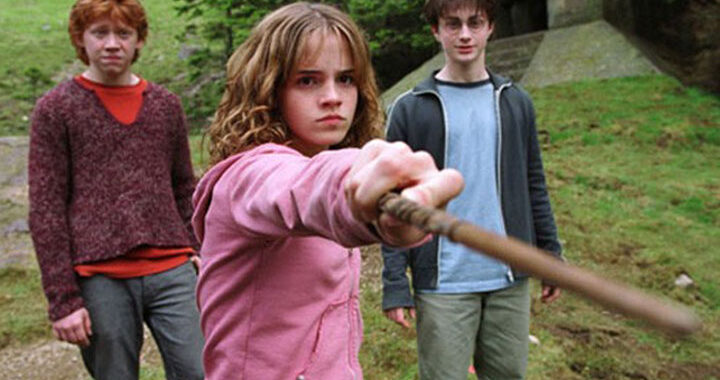
Irvin, Sam, and Sierra discuss how the Harry Potter series would change if Hermione was evil. They talk about the evil doings of Hermione, her victims, and if her motivations absolve her actions.
In this episode:
- Pyromaniacs aren’t necessarily evil
- Shame on Hermione for not paying writers!
- How to root out a traitor?
- What’s the worst thing Hermione did in the series?
- The more corruption she sees, the more radicalized she becomes
- Teen hormones: the root of all evil
- Could the locket have brought out the evil in Hermione?
- Would Hermione be more or less evil in a different Hogwarts house?
- She does all the bad things for all the right reasons
Resources:
- Hermione’s Revenge by Irvin
- Scary Side of Hermione Granger by Irvin & Lorrie Kim
The Pub’s Jukebox: Marietta’s a Sneak by Hawthorn & Holly



Hello, guys! I’m a long time Potter fan just as obsessed with the series as any other hard-core fan . . . in my constant pursuit of new content, I’ve stumbled across the amazing and sometimes weird world of podcasts! It’s awesome to see my favorite literary analysts and essayists talk about Potter on some of the sites I’m visiting. Thanks for everything you do! To Irvin specifically: I love your books; I’m proud to have Dumbledore and Malfoy, along with Snape, sitting on my shelf together. I’m hoping to see you at the CONjuration if I can make it . . . thank you all for your hard and brilliant work!
Awesome to have you listening to us! Thanks so much for commenting!
Of course, thanks for all the work you do to keep this fandom alive!
Aw, thanks so much for the kind words! So glad to have you with us, and I really hope you enjoyed Malfoy!
Hope to see you in November – I just got my flights and hotel 🙂
Nice! Keep writing your awesome books and essays! (I’m looking forward to that new Death Eater book too. . . .)
Another great episode! I really enjoyed your debate about Hermione’s evil side. Irvin, I am curious to find out if your take on Marietta’s punishment is influenced by Soviet thinking that traitors must be found and punished. I am of two minds–on one hand, I feel that Marietta should have been revealed but on the other hand, I will support Sam and Sierra that the punishment did not have to be permanent scarring.
I refer to Sirius’ words of wisdom, “We all have light and dark inside of us and it depends on what side we choose to act on.” I think that Hermione is inherently good but she reaches into her dark side to do what is right in the moment. Starting the DA was an “emergency” in her eyes, so she may not have thought the parchment charm through to the end. I feel the same about her putting the confusion charm on Cormac in tryouts. I think Cormac should have made the team and then be kicked out after Harry saw the bad team chemistry.
Looking forward to a new episode soon!
Considering I was born in New York City after the Soviet Union had collapsed, I doubt it! More that loyalty, especially to friends, is a core value for me (Hufflepuff – Hiiiiii!) – a betrayal like Marietta’s is one of the worst things I can conceive of doing.
Marietta’s punishment is even more egregious when you remember that – until the new educational decree – the DA is a perfectly legitimate study group (just one Umbridge would not approve of). No-one would be expelled if someone blabbed to Umbridge (except maybe Harry, but he’s got priors).
The first post-decree DA meeting should have included a “we’re illegal now, so if anyone wants out…” discussion. Marietta should have been allowed to opt-out at that point, when she can truthfully state that she doesn’t know whether the group has continued.
Umbridge is not above using Veritaserum on students. Is it even confirmed that Marietta betrayed the DA of her own volition?
Counterpoint – Marietta (and anyone else) was free to leave at any point, to not come to any further meetings, to ditch the group when it became illegal. No one held a wand to her head and forced her to keep coming.
I would say that, re: Marietta and Veritaserum, absence of evidence is evidence of absence. Cho, when defending her, never brings up Veritaserum. Snape certainly makes it seem like he just gave Umbridge a smidge of Veritaserum to interrogate Harry. Dumbledore also says that Snape gave her fake Veritaserum, so even if Umbridge tried to use it on Marietta, it wouldn’t have compelled her to tattle. And, in OotP, Jo generally spells out Umbridge and the Ministry’s abuses for the careful reader (Willy Widdershins, etc.). So I would find it pretty unbelievable that Marietta had been truth potioned and it never came up.
I will say, the film adaptation where Cho was subject to Veritaserum was a very elegant bit of adaptation, which cut out a lot of subplot without really breaking characters or logic. But that was only ever a movie-ism.
Oh, I completely agree that Marietta could (and should) have left long before (peer pressure can be a terrible thing). But that doesn’t absolve the group’s leadership of their responsibilities.
—
It wouldn’t be the first time I’ve been misled by a movie-ism (lol)! But I still feel that permanent consequences is going too far.
It feels like you should have settled on a more concrete definition of “evil” to start with, as you seem to be arguing from different moral/ethical frameworks. I don’t know whether Hermione’s actions are “evil”, but she certainly crosses the line into cruelty sometimes.
Based on the Weatherwax Maxim (“Evil starts when you begin to treat people as things”), there’s a couple of other victims you could mention:
You’re definitely correct on the first part – I suppose “evil” is one of those things that seems obvious right up until you start trying to debate it!
I dunno if I quite agree with the examples you bring up. They’re all somewhere in the “not cool!” range, but I don’t think any of them qualify as really objectionable. She’s not causing any harm (Crabbe and Goyle are just asleep for an hour), give or take Cormac… and teenage dating can and will result in hurt feelings, it’s kind of par the course.
That’s why I’m not a fan of a purely consequentialist framework, because no-one can know/control all of the consequences. What if Goyle had suffocated in his sleep? The trio’s actions hadn’t changed, but the consequences had.
Attempted murder is still a crime, even if the victim is unharmed.
—
Another victim I can’t believe I forgot to mention: her parents! Though arguably, they might have been on board with the plan (I don’t think it’s ever specified).
This was an interesting episode to revisit the podcast with. Admittedly, it was my first time listening to an episode in a month or two (just been overly busy and have been binge listening to Dungeon Crawler Carl-which I highly recommend, btw).
I think I agree with the commenter that said you probably should have discussed a definition of evil before the episode started.
“You can have good intentions, and still do harm” is the overall theme of one of my novels (as an indie author) and I couldn’t help but think about that throughout the episode. Hermione has every good intention in the world with all the harm she does, and yet, she undoubtedly does harm. To Marietta. To Umbridge. To Rita. Did they harm her too? Yes. But as they say, an eye for an eye makes the world go blind, two wrongs don’t make a right, etc.
I’ve never been entirely convinced Hermione was targeting the centaurs specifically. She wanted something to come out and attack Umbridge, but I don’t think she really cared what it was – thestrals, centaurs, Grawp, acromantulas, unicorns, an enchanted flying car. It was a desperate move by her since she was backed into a corner, but all in all, it did work out. Can you imagine if she, Harry, and Umbridge ran into the acromantulas instead? (Side note: is Aragog sick at this point? Would he recognize Harry and help him? Doubtful, but interesting to think about. Harry could be like, “Hagrid’s gone because of HER, Aragog!” Would that be a better fate than the centaurs for Umbridge? Possibly.)
Will forever be wishing they took the car to the Ministry of Magic.
I get where you’re coming from, but I don’t think this makes sense. Hermione is knowledgeable about fantastic beasts (and where one might find them). So, running down your options…
Hermione’s only options where she has a solid chance of establishing hostilities with Umbridge and then having her neutralized is the centaurs and Grawp, unless she’s found a way to domesticate the wild Ford Anglia.
I imagine Grawp was the backup plan, but he’s unpredictable because there’s almost no communicating with him. And if he were the initial plan, Hermione would’ve just made a beeline for his clearing instead of wandering loudly and aimlessly through the forest.
We are told though that thestrals and unicorns can take care of themselves. I can’t imagine Umbridge wouldn’t have attacked the creatures if they stumbled upon them.
The car would undoubtedly remember Harry and might feel a sense of duty to him for one reason or another. I think this one could’ve worked with a little bit of in-text explanation that obviously isn’t present in the real version of the books.
Ultimately, I agree that centaurs and Grawp work best due to Umbridge’s racism as established.
I do find it interesting that the text specifically states that Hermione was leading them towards Aragog instead of Grawp. Granted, Hermione wasn’t there the first time, so maybe she doesn’t know the way. But you’d think if Grawp was the backup, she would’ve made it a point to stay at least somewhat on the trail to him.