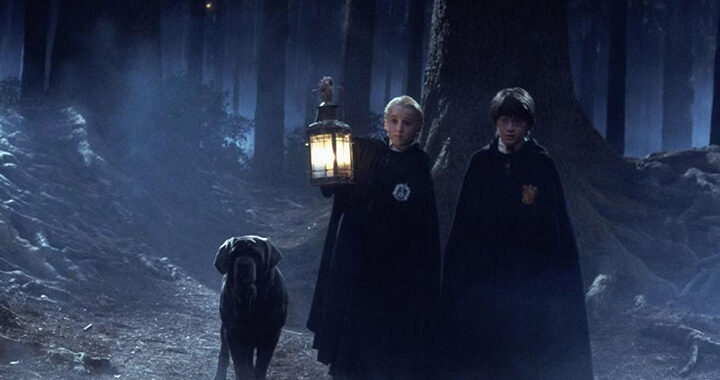
Special guest Grace Candido-Beecher joins Aureo, Sam, and Sierra to discuss the 15th chapter of the Harry Potter series: The Forbidden Forest. We talk about unreasonable detentions, the centaurs, and other creatures in the Forbidden Forest.
In this episode:
- The betting tails of Minerva McGonagall
- “But all my fwiends are angry with me!”
- Once again, Quidditch confuses us
- Dumbledore’s master plan is the reason for this detention
- Filch is a poltergeist
- McGonagall’s woo-woo meditations
- Do we want to fix Draco or make him worse?
- What do you think are the effects of the cursed life from drinking unicorn blood?
Resources: Voldemort: The Definitive Study of Tom Riddle by Grace Candido-Beecher

A fantastic episode! Grace, the Carlin Brothers also subscribe to the theory that Filch is the Anti-geist to Peeves. It makes a lot of sense that he embodies rules and order while Peeves is pro mischief and mayhem. Looking forward to November episodes!
Looking forward to your book, Grace!
The only way I can justify the choice of detention is that the whole thing is an elaborate “scare them straight” exercise.
Why else choose to have Filch take them down to Hagrid’s hut (rather than have Hagrid come up to the castle): so he can regale them with worst-case-scenarios on the way.
(Incidentally, much as I like the idea that he’s the anti-peeves, he’s probably just someone that’s really into medieval history and doesn’t realise iron maidens etc were largely fake.)
It’s like the trope of someone catching a kid smoking and making them smoke the whole pack at once. You want to be out after curfew? Well how about all night!! In the Forbidden Forest!!!
No-one except Hagrid thinks there’s actually any risk; and he seems unusually serious and distracted (probably also why he doesn’t think to apologise to Harry & Hermione).
That’s a valid suggestion, since this whole situation seems to be pretty out of the norm for Hogwarts standards. I still think it’s Dumbledore meddling and somehow convincing McGonagall this is a valid reaction, which I’d love to seen that conversation!
But “scaring them straight” is an equally wild method, but probably not too out of character for the time period.
And you’re right, Hagrid like most adults in this chapter is out of character too, but in a way where he’s taking the situation as seriously as he should. However, still interesting that he splits up the kids, seeing as they cannot do anything yet if they are faced with danger.
Awesome episode, guys!
I’m currently annotating the Unofficial Harry Potter Companion series for fun, and I thought I’d share one of my notes from the analysis of this chapter:
The tone and language of the Centaurs throughout this chapter provide evidence which makes it almost certain they knew of Harry’s death at Voldemort’s hands in the Forbidden Forest. With this assumption in mind, (and the knowledge of events that transpired in Deathly Hallows,) the Centaurs’ scenes take on a whole new, darker meaning. The fact that Mars was bright on that particular night did not literally mean, “Harry Potter will be killed by Lord Voldemort in the Forest,” but we learn later from Firenze that it meant a new Wizarding war would soon break out. (OotP 603) The centaurs must have believed that Harry’s imminent death would be the catalyst for said war. My interpretation is as follows: the Centaur’s statement that “Mars is bright tonight” was essentially a sad exclamation about things to come. “The innocent are the first victims,” when first read, may seem to be a reference to the fallen unicorns, but I believe that it has a much more sinister meaning. The Centaurs obviously think that Harry is about to die (SS 257), so I believe that it is an encrypted reference to him: another sad exclamation, worded in such a way that Harry (and the others) would not understand its meaning. Finally, Bane’s remark about “setting [themselves] against the heavens” is clear proof that he believes Firenze has interfered with predestined events – and Harry actually picks up on this, speculating that his death in the Forest at Voldemort’s hands was foreordained. (SS 260) I wonder if Dumbledore ever talked with the Centaurs in an attempt to learn about Harry’s fate, and if so, how the information he learned affected his ultimate plan for Harry’s sacrifice. I doubt it . . . I feel that he would rather remain ignorant to the knowledge than chance hearing a horrible truth, similar to the way he shut himself off from learning who killed Ariana in Godric’s Hollow so many years ago. In the end, the Centaurs are definitely far wiser and more knowledgeable about the future than they seem. It’s a shame we get to see so little of them, due to their detachment from Wizardkind.
Looking back on this annotation makes me rethink a lot of what I wrote, but I still agree with pretty much everything I said. What do you guys think? I’d love to hear thoughts, or get proven wrong!
Keep up the great work!
I want to push back against your assumption of Dumbledore’s willful ignorance. Dumbledore is a seeker of knowledge, we see how assiduously he seeks out any and all information that could in any way be relevant to the war against Voldemort. I believe the Ariana comparison doesn’t really hold up – that’s not information that’s relevant to any bigger goals of Dumbledore’s; the only point of learning that information would be personal recriminations and guilt. It would also be traumatic for Dumbledore to learn the truth of that moment.
With the Harry-vs-Voldemort war brewing, Dumbledore has no trauma that’s being dug up by that information. In contrast, he is spending years of his life focused on machinations around Harry’s survival (or lack thereof) against Voldemort. In my opinion, it would be wildly out of character for Dumbledore to avoid information about that grand master plan on the off-chance it would be upsetting.
If Dumbledore did not seek out the centaurs’ counsel, it’s because he has a self-professed disdain of divination as a very imprecise art. We see the truth of this: in that the centaur’s predictions that Harry will die in the forest are off by six years; in the fact that “the innocents are first to die” is a reference to Cedric dying and not just unicorns; and in how “Mars is bright tonight” foretells the second war coming, but it comes in several years. The centaurs’ predictions are very wise with the gift of hindsight, and (of course) a huge boon for foreshadowing and literary analysis… but in-universe, I don’t think they’re a reliable thing to act upon.
That was a great comment, looking forward to hearing more of them!
Thanks for replying!
I disagree. We see throughout the whole series that Dumbledore’s plans are skewed spectacularly by a care for Harry (most notably in King’s Cross and Harry’s Caps Lock scene at the end of OotP), and I think it is very in-character for him to refuse such knowledge. As you said, Dumbledore obviously knows that Harry might die at Voldemort’s hand by this point in the series. I think he would be afraid to learn whether or not Harry would die, because if his worst fears were confirmed, then Dumbledore would be afraid that he would be responsible for Harry’s death – talk about deja vu! [my point would be most relevant once Dumbledore knows about the Scarcrux (taking your book at its word, around the time of Ootp), but it still stands before that time – we see Dumbledore constantly putting Harry in controlled, mildly dangerous situations throughout his Harry’s first few years at Hogwarts.]
If I’m correct, you’re saying that my comparison to Ariana’s death is invalid because with the Voldemort war, any information about Harry’s fate is relevant as a possible war strategy, whereas only personal stakes are involved with the former situation. Setting aside Dumbledore’s care for Harry, I’d like to push back against this as well – first of all, I don’t really think the knowledge of Harry’s fate would be that helpful in the war. You just said yourself that in-universe, the Centaurs’ prophecies are unreliable to act upon. Dumbledore basically says the same thing in his monologue in the Horcruxes chapter of book six.
We do see, though, that some prophecies (namely, the one about Harry and Voldemort) only came true because the prophecy was heard. Dumbledore might have actually thought that if he did hear whether or not Harry would die, then him hearing that would cause it to come true! So the prophecy could have affected Dumbledore’s plan in a very unconventional way – it could have caused it, while also causing effects directly adverse to what Dumbledore wants. (That’s mainly what I was talking about in my comment above.) Of course, it could have also caused Dumbledore to form a plan that would have the desired effects, but . . . why take the risk, if either option is more or less an equal shot? Prophecies that only tell the ends of something, and not the means, can be very dangerous. And since, as you said, Dumbledore believes Divination to be a very imprecise branch of magic, he probably wouldn’t bet on getting any specific answers from the Centaurs (similar to the way he might’ve overheard his own time-turner plan, as you discuss in your book). So I don’t think he would’ve sought out the Centaurs’ knowledge in the wild hope that they would basically be able to explain his own plan to him.
I’m going to stop writing now, because my head is beginning to hurt. 🙂 Hopefully I haven’t contradicted myself anywhere! Thanks again for responding – it’s always exciting to discuss theories with fellow Potter fans!
Thanks for sharing that annotation!
I agree that “Mars is bright tonight” is their way to acknowledge that a sad thing is about to happen. I think my problem with all the works of prediction, call me Hermione, is that it’s always easy retroactively pointing at things and say “oh it must have been this”. Prophecies and predicitons are always worded vaguely to allow us to apply meaning after the fact, so if we want to read this hear as “Voldemort is rising again” or “a war is coming” then sure, but also Hagrid already told Harry Voldy will return, and predicting that another war is coming after seeing what happenend the last time, you don’t need to read the stars, tea leaves etc.
Sorry, I’m definitely team cynical when it comes to this stuff.
Not sure Dumbledore would talk to them, he seems to have some sort of connection to the centaurs, seeing as he hires Firenze in OotP, but not sure the centaurs care much for Dumbledore or most other wizards. For all we know, they might treat Hagrid kinder, because he isn’t a wizard.
You make a very good point about retroactively applying meaning to the prophecies. Mainly it’s just my obsessive compulsive brain trying (and failing, desperately) to give a defined meaning to every plot point or plot-centric line of dialogue in the series. However, from a meta point of view, and given the knowledge of the absolutely insane extent to which Jo wrote these books, it seems that if such dialogue as we see in this scene is introduced, then it should be paid off somehow. That’s how I landed on my interpretation of it, which I think is the most likely. Then again, I might be mistaking simple worldbuilding for a plot point. In that case, we’re not intended to have a defined understanding of what the Centaurs are saying, and I’m overanalyzing it. Either way, it’s a very mysterious scene to read, because you get the sort of feeling that the Centaurs are on a whole other level than our protagonists. This could of course, support either aforementioned viewpoint. Aaanyway. . . .
Thanks for replying! I’m looking forward to the next few episodes. 🙂
This episode got me thinking about the role of the Deputy Head. In the Harry years, McGonagall is essentially the Headmistress for the day to day operations of the castle. So…can she overrule Flitwick, Sprout, and Snape/Slughorn when it comes to student discipline? Did Snape actually have a choice but to “sign off” on Malfoy’s detention? McGonagall is the one who gave it to him.
That leads me into my next point. Why have a Deputy at all when we have Heads of Houses?
It’s a question of who’s responsible for what – think of it kinda like federal-vs-state in the US, where the federal government gets to tell the states what to do, but there are some areas where states get total say over what happens.
So any teacher can give detentions or dock points, as we see throughout the text – Harry gets detention from Snape and Umbridge, for instance. Should there be a standardization of the house point system? Yes. Should someone need to sign off on detentions, given how capricious some of the professors are? I’d argue that’s more a failing of who’s teaching, rather than the system.
The “I shall speak to your head of house” seems to be the boarding school equivalent of “I shall speak to your parents!” The heads of house are in charge of their students wellbeing, and need to know what’s going on with them; if a student is behaving totally inappropriately, beyond the immediate consequences, you alert the head of house so they can work with the student on fixing the situation.
I actually think the Umbridge/McG double act in early OotP is a perfect example of how this works: Umbridge gives an immediate punishment, then alerts the head of house as to the systemic issue (Harry speaking out in class). McG then talks to Harry, not about the punishment in question, but the larger issues: he needs to keep his temper, not yell at teachers, and listen to Hermione’s advice.
Oh I definitely see the value in having the Heads of Houses. And I agree that the teachers alerting the Heads of House about behavior problems is a good system to have. Though that doesn’t really address the broader role of the Deputy Head specifically.
We see throughout the series Dumbledore rely heavily on McGonagall. This can be explained away by “well Dumbledore’s busy fighting Voldemort!” What this doesn’t really explain is why, in Hogwarts Legacy for example, we see Professor Black rely on Professor Weasley for a lot of presumably his duties. (Idk how much value you want to give Hogwarts Legacy, but it was the first thing to come to mind, lol.)
So I fully agree with your comment but I guess it was more about how much authority does the Deputy Head really have over other staff members? We do see McGonagall confront Moody about the whole ferret situation. I’m trying to think of other examples we see where McGonagall confronts a staff member about something they’re doing. I feel there may have been something with Lockhart but I’m not remembering off the top of my head.
Which brings me to my next question. Unless she has a Time Turner, how on Earth can McGonagall possibly be Deputy Head, Head of House, and Transfiguration teacher all at the same time? Teacher alone (in any subject) is a full time job.
Snape seems to do okay with it all things considered, putting aside the fact that he’s also a double double agent but forgetting about that for a moment. How is there not room in the budget for a second Transfiguration teacher so McGonagall can do
more of Dumbledore’s jobher Deputy Head duties? Maybe she’s supposed to be doing observations and things and just isn’t because she doesn’t have the time.With respect to school administrators, who do lots of important work, my impression is that Hogwarts… kinda runs on autopilot much of the time. The teachers teach (with no oversight), they discipline kids (with no standardization or oversight), Madam Pomfrey keeps them healthy, heads of houses deal with behavioral issues and career advice… There really doesn’t seem to be much in the way of daily duties that McG would have to add to her (ridiculously full) plate.
The Deputy Head sends out the Hogwarts letters (which, one hopes, is somewhat automated). But a lot of the other stuff we see – names for Christmas stays, class schedules – might be in the role of Head of House. So I think a lot of her Deputy role is (A) the administrative parts of running the school, like the letters; (B) stepping in when Dumbledore is away, and Big Decisions have to be made.
Maybe that’s the issue is I’m trying to compare it to an Assistant or Vice Principal role, and it really doesn’t need to be. (I’m a teacher IRL)
An AP in a Muggle school typically:
So…yeah, I suppose the Deputy Head position would be mostly autopilot. Which is kind of insane given how overworked Muggle teachers and administrators are!
If anything, perhaps the Heads of House need to be split up into two positions. They’re essentially teachers AND guidance counselors. Minerva is just an AP on top of that.
Yeah, I think your last point is a good one. The Heads of Houses should either be someone who doesn’t teach a core subject (ie. Vector) or a separate position altogether. My impression is that the elective teachers have 8 different classes they’re teaching (at most), versus 12 different classes for the cores. Also, that would make for a fun situation where Trelawney and Kettleburn get to be Heads of Houses!
This is veering a bit off-topic, but since you brought up how much free time the elective teachers have. I am 100% here for an episode on the Hogwarts curriculum and staffing, if you guys ever decide to do one.
Core classes:
These are really the fundamentals as established in HP lore. I would equate these to reading, writing, arithmetic, etc. I am a firm believer that there need to be two professors for each of these subjects. (Could you imagine Dumbledore having to find two DADA teachers every year?)
I would also add either Muggle Studies (for those who grew up in the Wizarding World), or History of Magic (for those who grew up in the Muggle world). History of Magic would be totally revamped to be more of a “Wizarding World Studies” type of class. So either way, they’re essentially getting some form of social studies.
So that’s 6 classes, plus Flying lessons the first year. That might actually be a little too light. So what if 1st and 2nd year students rotated through the electives? Not for the whole year, but they took all 7 electives for 6-8 weeks or so? Add Flying in for an 8th class so it’s an even number, and they’d take 2 electives at a time only for 1/4 of the year the first 2 years.
After 2nd year, the elective rotation would drop, as would flying lessons. They’d then pick 3-4 of these classes starting in 3rd year. (Hermione does Care of Magical Creatures, Arithmancy, and Ancient Runes without a Time Turner, so we know 3 electives is doable.) We removed Astronomy as a requirement to make room for another elective too, so no reason a student couldn’t do 4 electives instead of 3 if they wanted to.
Then after 5th year, students could drop any classes they wanted with the blessing of their Head of House.
We could probably get by with only 1 teacher for each elective unless that elective was insanely popular.
The Heads of House would actually become full-time jobs then, and would not have regular teaching duties. But they would absorb the Deputy Head role into their four roles. The Heads of House would be responsible for writing to their houses prior to the start of term rather than McGonagall writing to everyone. (Which I suppose could be a thing anyway?) The Headmaster would be responsible for first years. The Heads of Houses would conduct teacher observations and involve the Headmaster if necessary. The Heads of Houses would be in charge of discipline except in cases of expulsion which requires the Headmaster’s involvement.
You know where our “Submit Topic” button is. 😉
Just to briefly address this. We know from OotP, there are 6 class periods per day, making for 30 total throughout the week. (Not counting Astronomy at midnight or whatever.)
The core subjects have three class periods a week, which makes for half the class periods already spoken for. Add two sessions of History of Magic, that’s 17 class periods.
So first/second years will have approximately 17-18 class periods throughout the week, counting Flying Lessons, which makes for four classes a day. That accounts for Harry’s “Friday afternoons off” in Year 1; I’d hazard a guess that they have 4 classes per day Mon-Thurs, and only two in the morning on Fridays. And probably the underclassmen don’t have classes later in the afternoon.
When it comes to the electives, we know that there are at least two sessions of each. So if one takes the minimum two electives, that’s 21 class periods, still leaving 9 open. That doesn’t add up, since it means one could do all five electives and have a full 30 periods – not fun, but doable.
So I think, to make it make sense, we assume there’s three classes per elective (and while we’re at it, let’s say a third History of Magic session). Then with the minimum two electives, you’re at 24 class periods – 5 a day. With three electives, like Hermione takes, that’s 27/30 periods full, more if there are any Astronomy classes during the day. And indeed, it would be impossible to do all the electives without a Time Turner.
I was shocked that throughout the conversation about McGonagall telling the kids off, all the hosts were taking her entirely at her word. Why should we believe she’s being entirely forthright, when everything she says is clearly a wild overreaction? The whole “it’s the first book, things don’t make sense” explanation is too facile, when there’s another obvious answer: McGonagall is strategically employing hyperbole to make a point.
She has seen plenty of students out of bed, late at night. In fact, she probably vividly remembers the father of one of the current culprits, and how he never gave her a moment’s peace. So when it appears that Harry, as a ringleader of his little gang, is sneaking out at night (as a first year!), McG is triggered and determines to nip it in the bud.
“This is the worst thing to ever happen!” “These are the most dangerous times we’ve ever lived!” “I could never conceive of such an infraction!” “Eleventy bajillion points from Gryffindor!”
McGonagall is trying to scare them straight – she, like Snape, fears that Harry might take after his dad.
For the record, I’ve been in quite a few cities that measure up to my sleepless standards – just none of the ones where the other hosts live! Berlin, Krakow, Budapest, and Buenos Aires all have plenty going on after hours!