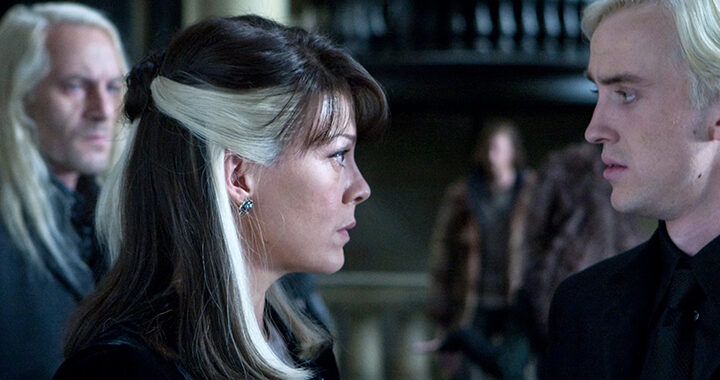
Special returning guest Natalie Candido joins hosts Aureo, Irvin, and Sophia to take a deep dive into the youngest Black sister and mother of our favourite ferret: Narcissa Malfoy
In this episode:
- How does one get a divorce in the wizarding world?
- Is Bellatrix a psychopath or not?
- Aureo and Bellatrix have so much in common!
- Sophia takes us on a flower and water journey
- Was there more going on in the Spinner’s End scene that we all missed?!
- Does Narcissa know about the ferret incident?
- Narcissa could have been crucial to ending Voldemort’s rise in Goblet of Fire
- Narcissa’s most badass moment and her motivations
- We speculate about Narcissa’s future
- Narcissa’s purpose at Malfoy Manor is to clean up corpses
Resources: Did Narcissa Really Mean It? by Kelly Gunzenhauser
Irvin’s books:
- Preorder now: Malfoy: The Most Treacherous Family by Irvin
- Dumbledore: The Life and Lies of Hogwarts’s Renowned Headmaster by Irvin
- The Phoenix or The Flame – a collection of essays from authors incl. Irvin
The Pub’s Jukebox: Narcissa Unleashed by Nagini


Okay, I’ve been listening to your podcast from the beginning and haven’t caught up yet, but I had to skip ahead for this Narcissa episode. Two thoughts:
I loved the discussion of whether Narcissa is a mastermind of impromptu schemes on the level of Dumbledore. I feel like she and Dumbledore have opposite approaches to their scheming. Dumbledore is brilliant in the realm of logical strategy, whether playing the long game or in the moment, but he often makes mistakes in the human/emotional realm (e.g. not foreseeing that ignoring Harry in Book 5 would have an emotional toll; not realizing Harry and Snape cannot put their animosity aside long enough for an Occlumancy lesson, etc.) Narcissa, on the other hand, operates almost solely on the human/emotional level. I don’t think she went into Spinners End or the Battle of Hogwarts with an intricate knowledge of all the strategies in play and the different logical outcomes they could lead to. But she knew Snape well enough to play to his vanity and personal affection for Draco. She knew Voldemort well enough to know that he wouldn’t double-guess her and check for himself whether Harry had a heartbeat. And she knew Harry well enough (despite their very limited interactions) to trust in him to follow through with playing dead and lead her safely to Draco. She revealed her true priorities to him by asking about Draco’s whereabouts and knew that he would give an honest answer. Ultimately, I don’t think Narcissa had the kind of elaborate strategy-based schemes Dumbledore had, but she always knew the right person to go to for a particular problem and the right way to approach that person, socio-emotionally. She could wing it from there. (Relatedly, Dumbledore does a lot of acting on his schemes alone whereas all of Narcissa’s schemes that we see rely upon another person.)
Second thought:
Regarding whether Narcissa’s actions at the Battle of Hogwarts absolve her of her other misdeeds, while that doesn’t cut it for my personal ethics, I kind of agree that within the logic of the books (or at least Harry’s logic), maybe it does. Harry is willing to name one of his children after Severus Snape despite hating the man for seven years and seeing the many horrible things he’s done, all because he died for the right cause in the end. Then again, perhaps it’s that idea of sacrifice that actually absolves Snape in the logic of the books. If Narcissa died, would that absolve her? Or at least get a kid named after her?
Also random fun fact I just discovered in my googling: there is a sub-species of Narcissus flower sometimes referred to as Hermione. I doubt JKR knew this while writing or had anything about this connection in mind, but it does make me want to muse upon any possible parallels between these two women…
It’s very good to have you with us commenting!
First thought…
I don’t think it’s fair to ascribe a tendency towards human/emotional mistakes to Dumbledore. As he himself says, “being rather cleverer than most men, my mistakes tend to be correspondingly huger.” You mention his two most egregious missteps, and fair enough… but we see Dumbledore enact all manner of plans, and work with all manner of people, and 98% of the time he absolutely nails how to work with them. With Narcissa, we have a sample size of two or three… if we saw as many of her interactions and we did Dumbledore’s, I don’t think she’d bat 1.000
That said, I agree with you that Narcissa is absolutely fantastic in the realm of emotional intelligence, and that most of her plans rely on people behaving as she expects them to. And I like how you pointed out that she always relies on other people in her plans, whereas Dumbledore doesn’t. That is part of a broader pattern in Jo’s writing (credit to David Martin for the idea) – good guys use books, bad guys use people. It’s what tripped Crouch Jr up, when Harry wasn’t going to anyone and everyone for help with the second task, but stubbornly poring through the library.
Her reliance on others does make me wonder, again, whether or not Narcissa is powerful in terms of magical ability. We’ve no evidence either way, but it would be in keeping with her strategy of turning to other people if she wasn’t a super-powerful witch.
Fanfic where Narcissa is a squib and spends her life adeptly hiding it from literally everyone – I would so read it!
Second thought –
Glad I’m not alone in at least considering Narcissa’s absolution! I think a heroic sacrifice would absolutely make her a hero in Harry/Jo’s eyes, because nothing gets a Gryffindor going quite like noble sacrifice – it’s the ultimate Gryff move! If it had happened, we’d have Lily Narcissa Potter… which I think is actually a very good name (considering the two women’s parallels).
Personally, I’m not a huge fan of “he sacrificed himself, it fixes everything!” storytelling choice, because it’s more interesting to have to work towards redemption and live with guilt… but that’s just me.
Redemption is a tricksy topic (worthy of an episode, perhaps?), because what qualifies as redemptive from one person/character’s perspective may be not-good-enough from another’s.
(See also: the perennial Snape debate)
As much as Harry appreciates a noble sacrifice, it’s usually the audience you have to convince of a character’s redemption, and – ironically – having other characters disagree on the subject can be a useful tool for that.
Absolutely! Redemption is definitely in the eye of the beholder.
I would actually really love it if Rowling wrote a scene (preferably in 2008) of the Trio debating Snape/Narcissa/Draco’s redemption, and getting their perspectives on it… I think it’d be fascinating! I imagine Ron would be fairly intransigent and unforgiving, Hermione would try to give them benefit of the doubt and empathize with them, and Harry would have way more respect for whoever died in the process.
“Daffodil” does trace its origins to “asphodel” (a type of lily), so the parallels keep coming!
Oh, that’s awesome!
* frantically emails publisher, “is it too late to change something three days before Pub Day?” *
Hermione/Narcissa parallels –
I think it’s very fertile ground to explore! The first thing coming to mind is how they use their brains, observe and remember important information when needed. If roles were reversed at Malfoy Manor, Hermione would’ve absolutely known who Harry’s friends are, what his wand looks like based on Ollivander’s description, and so on.
There’s also the way they will defy authority as needed despite the emphasis placed on respecting it. For Hermione, the Hogwarts professors are somewhat sacrosanct as authority figures, yet she will still hex Snape in the Shrieking Shack and foment rebellion under Umbridge. For Narcissa, doing anything against the Dark Lord’s wishes constitutes “great treachery,” yet she still goes to Snape in Spinner’s End.
But the most striking similarity, for me, is their caution and desire for all the facts before acting hastily. Think of Narcissa at Malfoy Manor, wanting to verify Harry is Harry, reminding Lucius that they had better be damn sure before doing anything drastic. That’s the exact same energy Hermione brought to “Out of the Fire” in OotP – before rushing off to save Sirius in the Ministry of Magic, let’s actually make sure he’s there! Let’s check Grimmauld Place, let’s have all the facts, and then let’s do what needs doing. Their behavior in these scenes is actually remarkably similar.
This was a very fun musing – like you said, I doubt it was particularly intentional (though it might just be how Jo writes competent badass women), but it’s a very interesting connection!
I think (depending on the unspecified laws/norms around divorce in the wizarding world) Narcissa would leave Lucius if-and-only-if it would ensure Draco’s future (e.g. distancing themselves from Lucius to keep Draco out of Azkaban), and she could probably convince him to “fall upon his sword” in such a circumstance. Fortunately for both of them, Harry speaks up for the Malfoys, so they don’t have to do anything drastic.
—
The whole “setting Bellatrix on Tonks” scene speaks to me not of Bella’s sadism, but of Voldemort’s.
Sadism seems related to using fear/pain/humiliation to exert control and dominance over another; exactly what Voldemort is doing to the Malfoys, and he then has to take Bella down a peg when she speaks out.
(Psychopathy is more about selfishness and lack of empathy – think your stereotypical smarmy CEO.)
Bellatrix is only interested in controlling/dominating those she sees as “other”; muggles, muggleborn, etc. She seems happy to defer to Voldemort, or even Lucius (back when he was still in favour). Voldemort came from nothing so is more invested in staying atop the pecking order.
Agreed about Narcissa and divorce.
To your point about Bella – I think she enjoys hurting people in general, not just “others.” Think of how she came alive at the prospect of torturing Neville, who is thoroughly pureblooded. My understanding is that a sadist like Bellatrix or Umbridge would be thrilled to hurt anyone.
Voldemort, on the other hand, seems to use torture and pain largely as tools to impose his will, but iirc we never see him revel in the process the way Bellatrix and Umbridge do.
I think that’s the distinction between the common definition (“enjoys causing pain”) and the clinical definition (“causes pain to impose their will”).
Those three do show the different “flavours”, if you will: Bellatrix enjoys it for it’s own sake, Umbridge enjoys it and uses it as a tool, Voldemort uses it as a tool.
I wonder how much of it is due to Voldemort’s advanced “I am become more than a mere wizard”-ness? (His general vibe of having put aside other pleasures). Diary Tom certainly seemed to be enjoying toying with Harry in the Chamber (at least as long as he was in control of the situation).
Good point.
Diary Tom enjoys toying with Harry, but not hurting him. He doesn’t torture Harry, or have the basilisk bite off one limb after another, or anything like that. The only time we see Voldy torturing Harry is when he’s putting on a show for the Death Eaters in GoF.
I think it’s helpful to consider control vs pain as separate things the villains like. As you say, Bella enjoys the pain, but doesn’t really seemt o care about subjugating others. Voldemort wants to be in total control, probably going back to his mommy issues (she couldn’t control dying!), but views pain detachedly as a tool among others. Umbridge really is the unholy marriage of the two, who gets off on pain and control.
Basically, this is why there are separate Unforgivables for control and for pain, rather than just one torture curse that wizards would use to coerce certain behavior.
Attempting to reconnect after estrangement is always going to be awkward, but especially so if one party is more ready to move on than the other.
I can imagine Narcissa feeling that with both Ted Tonks and Bellatrix out of the picture, her and Andromeda can put their differences behind them. Andromeda’s response would probably be unprintable (especially if Narcissa isn’t willing to aknowledge Teddy).
—
There’s a saying to the effect that “people prefer to remember the version of you they had the most power over”, which is often demonstrated by parents or older siblings not recognising someone’s independance/autonomy.
Oh, that’s a very good point – I could totally see Narcissa reaching out with a fair accompli attitude, “We’re all we have, of course let’s let bygones be bygones!” And as you say, Andromeda is gonna need a lot more than that to get on anything more than “meet at the cemetery once a year” terms.