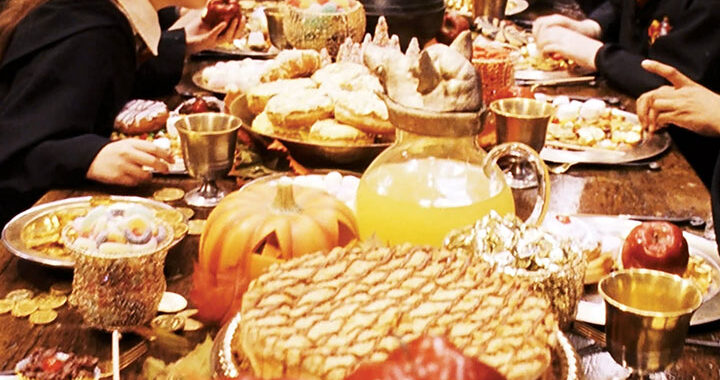
Christian Richardson joins Aureo, Sam, and Sierra to discuss food in the Harry Potter series. We talk about the importance of shared meals and how different characters are portrayed through food.
In this episode:
- Gamp’s law around food
- Feasts served with a pinch of slavery
- British food culture doesn’t seem to reflect the importance of food in the Wizarding World
- Absences from meals at Hogwarts are noted
- The trio handles the absence of food differently
- Dumbledore occasionally eats something that isn’t candy
- Bacon sandwiches trump everything
- Food is a love language in Harry Potter
- Mars bars are not bright tonight
- Death Day catering is where the money is at
Pub’s Jukebox: Honeydukes by Justin Finch-Fletchley and the Sugar Quills

There was an episode a while back – I think the “Plot Holes: Logic Wins Again” one? – where there was quite an extensive discussion on Gamp’s laws. The idea is, if anyone could magically increase the quantity of food in their possession indefinitely, then why should hunger ever be a problem in the Wizarding world? This calls in to question why the trio needed to forage for food when they were on the run during the Horcrux hunt. It also creates bigger problems, like: how on earth do food manufacturers and shops in the Wizarding world stay in business? There’s no apparent reason why Harry or anyone else couldn’t simply buy a single chocolate frog a year, and continuously multiply it throughout the whole year until it goes bad (eating the copies). It also instigates some quite serious ethical dilemmas – are Wizards wrong to ignore the constant suffering of Muggles due to starvation when there seems to be a relatively easy solution?
I think the only way to justify these alleged plot holes is to assume that as food is multiplied, it loses basically all taste and nutritional value. As more and more copies are created, they become less and less chemically stable. This makes sense – after all, if Transfiguring food changes its basic chemical structure, then why shouldn’t multiplying it change its basic chemical properties? If my theory is true (and I think it has to be,) then no one would waste time multiplying food because it would lose almost all its bioavailability in the process. This theory also applies to potions, since they are composed of the edible by-products of magical animals. This explains why no one just duplicated a vial of Felix Felicis or a bit of Polyjuice Potion whenever they needed it.
We know that you CAN conjure substantial food, as long as it is taken from another source. For instance, when the food at Hogwarts appears on the tables at meals, it doesn’t just come from nowhere. It’s already been carefully prepared by the House-Elves in the kitchens and as the food in the Great Hall increases, the supply in the kitchens is slowly drained. We have to assume that this is also true in other cases, such as McGonagall’s replenishing sandwiches in CoS. But when there is no other source, my theory steps in. (Of course, more questions inevitably arise, like: why didn’t the trio set up a direct connection between Hermione’s bag and Mrs. Weasley’s pantry, or something similar? But that’s a matter for another time.)
What are you guys’ thoughts? As absurd as it sounds, sometimes the only way to get answers is to look at the science behind the magic!
I imagine you’re right – there’s probably some sort of limitation on multiplying food or the whole question of food shortages breaks down.
I thought Potions (and Magic in general) is one of the five exceptions to Gamp’s Law. Because, again, society breaks down if you can multiply Felix Felicis or Invisibility Cloaks, etc. I think that would probably be more consistent than Potions falling under the subheading of Food.
As for why Hermione didn’t create access to the pantry… I think access to food was one of the things they just didn’t plan for. One of those things, if you’ve never had a total shortage of food, you’d never consider that as a problem that needs solving. (I liken it to the fact that, as a New Yorker, I’ve had quite a few dramatic adventures where I got completely stranded somewhere remote because it never occurred to me that I wouldn’t be able to call an Uber or a car service in the mountains of Pennsylvania. It’s just not something you realize you need to think about.)