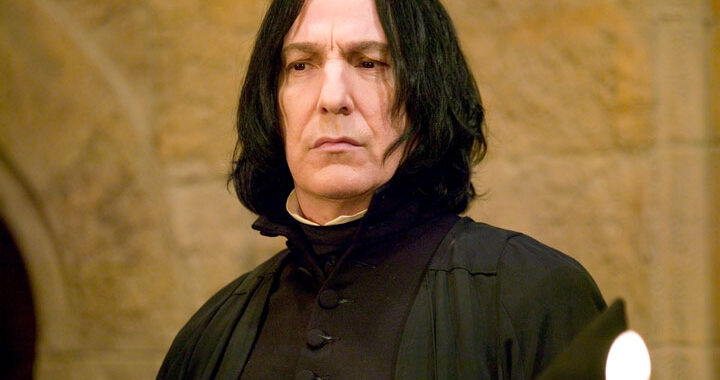
Join hosts Sam and Sierra and guest Neiha Khan (Dramione Diaries) as they delve into the many what-ifs of Severus Snape book-by-book.
In this episode:
- Pretty privilege, does it always work?
- Snape caring for Harry changes everything, or does it…
- Rogue bludgers for Snape no matter what
- Snape killing Lockhart would be chef’s kiss
- Let the people talk!
- Snape surviving Azkaban has many forms
- Everything changes if adults don’t act like children
- Harry failing at Occlumency is actually good
- No awkward hugs, just death
- Snape could change everything or nothing

I loved this episode so much! I have my own “what if” to offer for Sorcerer’s Stone. What if Harry actually understood Snape’s comment in the first potions class about asphodel and wormwood, meaning that Snape regrets Lily’s death. Do you think Harry would have set his fear of Snape aside to speak with him at least about Lily? I think he would have and should have!
Wait is that a thing? Was Snape giving a coded message about Lilly?
I must have missed that!
Some fan (cannot recall who) an age ago worked out that the plants Snape mentions – via the “language of flowers” – imply something like “I regret Lily’s death”.
I like the idea that Snape is sort of testing Harry in this first class. He’s thinking something like “Lily would know this; Potter’s clearly as dunderheaded as his father”, not realising that he’s comparing Harry at 11 to Lily at 15/16.
I don’t think Snape is willing/able to see Lily in Harry.
At first it’s probably subconscious, owing to his appearance and a lot of confirmation bias. When Dumbledore reveals that Harry needs to die, Snape has even less reason to look for her traits, until dying himself and in desperate need of compassion from one of the only people who ever cared about him.
—
It’s interesting to look at Snape’s first interaction with the marauders. They ignore him until he mentions wanting to be in Slytherin. James reacts rudely (echoing Draco with “I think I’d leave, wouldn’t you?”), but then goes back to ignoring Snape. Snape repays the favour by sneering at Gryffindor, Sirius snarks back, and animosity is established for stupid, immature reasons.
(Note that while Harry immediately dislikes Draco, it’s because he reminds Harry of Dudley, and he’s openly bigoted (towards Hagrid and muggleborns). Also, Harry’s response is to want to avoid Draco rather than needle him.)
—
A makeover wouldn’t have helped Snape much once his “greasy” reputation had been established. Unless he achieved a Hermione-level immaculate glow-up (the marauders: “Oh no, he’s hot!”), kids would take it as the defense mechanism that it is.
There was the chance for a fresh look and a fresh start when he became a teacher, but at that point he was too busy grieving to care.
—
A lot of people suspect that both Snape and Dumbledore are constantly using (light/passive) legilimency on students, but at that level it’s probably only good for distinguishing “they have no idea what I’m talking about” vs “they’re super guilty”.
(It’s an invasion of privacy, sure, but at least it’s fairly accurate. Unlike Umbridge’s “you’re guilty because I don’t like you”.)
It’s less useful in more open-ended scenarios, like Dumbledore’s “anything you’d like to tell me” in CoS. It’s not clear what Dumbledore is looking for, and Harry’s thoughts are probably not terribly useful. Maybe they’re even unhelpful – if someone’s brewing polyjuice in Myrtle’s bathroom then clearly there can’t be anything else going on in there.
Snape does make a habit of eavesdropping but only getting half of the story. I’ve wondered at what point he realises/accepts Sirius didn’t betray the Potters. Either way, he still hates Sirius, but does seem to warm up to Lupin (slightly) after learning Lupin wasn’t in on The Prank.
—
Azkaban would cause Snape’s love and grief to twist to bitter obsessive grudges? Isn’t that what Snape is like anyway?
(I mean, I can sort of relate – being forced to put up with *dramatic shudder* teenagers every day would probably suck the joy out of my life, too)
—
If another Death Eater rather than Snape heard the prophecy, Harry dies. Lily’s sacrifice made a difference because she was given the option to step aside. No other Death Eater would have asked Voldemort to spare her.
Only Dumbledore hears the prophecy? Goodness only knows. Dumbledore certainly isn’t going to tell anyone if he doesn’t have to, and Voldemort doesn’t have a reason to go after the Potters (other than the standard moustache-twirling “you have thwarted me for the last time!”)
I like Irvin and Sophia’s prophecy explanation that it happened because circumstances aligned to make it occur (so Trelawney goes into a trance because Snape was eavesdropping).
There isn’t a definite time for when the prophecy happened (there’s an essay about this called “When the Prophecy Was Made”), but I lean towards it being Halloween of 1979, both because Halloweens always mess up Harry’s life, and that’s 9 months before Harry’s birth.
Really shocked Neiha Khan’s “nasty little rat brain” comment about JKR was left in.
I’ll be skipping any episode she shows up in in future. I wish people like Neiha would just leave the fandom. I’m so done with this energy.
I’m very late to the party so this may go unseen. Nevertheless, I had a few thoughts while listening to this episode and wanted to share.
First, Sierra brings up the idea that Bellatrix derives pleasure by the harm she causes, so how could that joy remain after being in Azkaban where the Dementors would’ve have sapped her of her happiness. The implication being, as Sierra suggests, that should wouldn’t want to cause harm anymore.
It’s an interesting thought, but I think something important is being missed. This may be a bit general, but “happy” people don’t hurt people. Rather, sad, sick, or scared people do (and angry, which is a masking emotion often tied to fear). I’d argue that Bellatrix is never happy. In fact, I’d argue she is in fact sick. So, the effect of the dementors only made her sicker. As a result, she comes out even more deranged.
__
Next is a topic I have a lot to say about but will keep it brief here (I’ve been tempted to post about this several times when it’s come up. Most notably during the Father’s Day episode, which made me so upset I couldn’t listen past the first few minutes).
In defense of Lupin.
It’s been suggested a few times (in this and earlier episodes) that Lupin’s absences from Harry’s early life is evidence that he a failure. First, I think Lupin would be the first to agree, which is at the heart of what I want to bring up. Before that, though, he’s also been characterized, as the guest host said, a “deadbeat dad,” and that his actions in DH diminish his character greatly. Again, I don’t think he’d disagree.
As Lupin says himself, “Fear makes people do terrible things.” And Lupin (like Bellatrix above) is scared. And sick. I have always read the werewolf as a metaphor for specific kinds of sicknesses. Namely, depression and/or addiction. In this light, I think it’s a bit callouses to not consider his actions as a symptom of his sickness. It’s like being upset with a person suffering depression for not laughing once and a while. He’d like to but he can’t. Not only this, but he hates himself for this sickness, which compounds the symptoms. Which is to say nothing about the widespread prejudice against people with his affliction – a whole line of thought I won’t go into here.
I would argue that it’s rather honorable and brave (he is Gryffindor, after all) that despite his affliction he shows up in the way that he does. As a kind, fair, and thoughtful teacher. He hates himself every moment of his life and yet he shows up with love and kindness.
Yes, his self-hate does manifest in some pretty bad ways. Namely, attempting to run away from Tonks and Teddy (the so called “deadbeat dad” moment). Again, I think it’s unkind to judge him so harshly, as the guest host and Harry do. Consider this is a man with an addiction, which he is in treatment for. Then he has a relapse. Does that relapse count for all of who he is? Does the relapse mean he is just an addict and worthless? No. Because the next day he begins his work toward sobriety again – to be who he actually is (a sentiment HP fans should be familiar with).
Like this analogy, Lupin makes a mistake as part of a deeply worn pathway symptomatic of his affliction. And like this analogy, Lupin, despite the affliction, returns home. The next time we see him he is happy. Actually happy. And full of love. He is still a werewolf and will likely continue to battle how that makes him and others see him, but he has made one massive change. He has allowed himself to love and be loved.
A few episodes it was discussed that Lupin, beyond PoA, doesn’t serve much of a point. I think there was some good arguments against that, however I think this scene is very important as evidence against that sentiment. The last time Harry saw Lupin was when he was at his worst. Harry couldn’t think any less of him. The next, Lupin bounds in full of joy, names Harry godfather, and they all laugh. In the midst, mind you, of war. This is significant for a few reasons. Not only does it show that Lupin is who he wants to be (someone worthy of love), but it shows Harry that people are complex (not just good people and Death Eaters), which is an important thing for him to keep in mind as he goes off to war and face not only the duality of Snape but also the reality of what is inside of him – a piece of Tom’s soul. I could go deeper into this, but I’ve already gone on way too long.
In short, try to have some empathy for Lupin. He would for you.
__
Finally, after Sierra listed her seven worst Snape moments she listed her favorite – when he goads and mocks Lockhart into going to the Chamber and to “save” Ginny. I hard disagree on this being a shining moment for Snape. He’s essentially choosing to bully Lockhart rather than support a solution that would save Ginny. He himself should’ve gone. But instead, he goads Lockhart, knowing full-well that he isn’t up to the task and will fail. The result of that failure, one would assume, would be Ginny’s death. The death of an 11-year-old student. Yeah, not a good look on Snape.